Regulation / Crypto Regulation

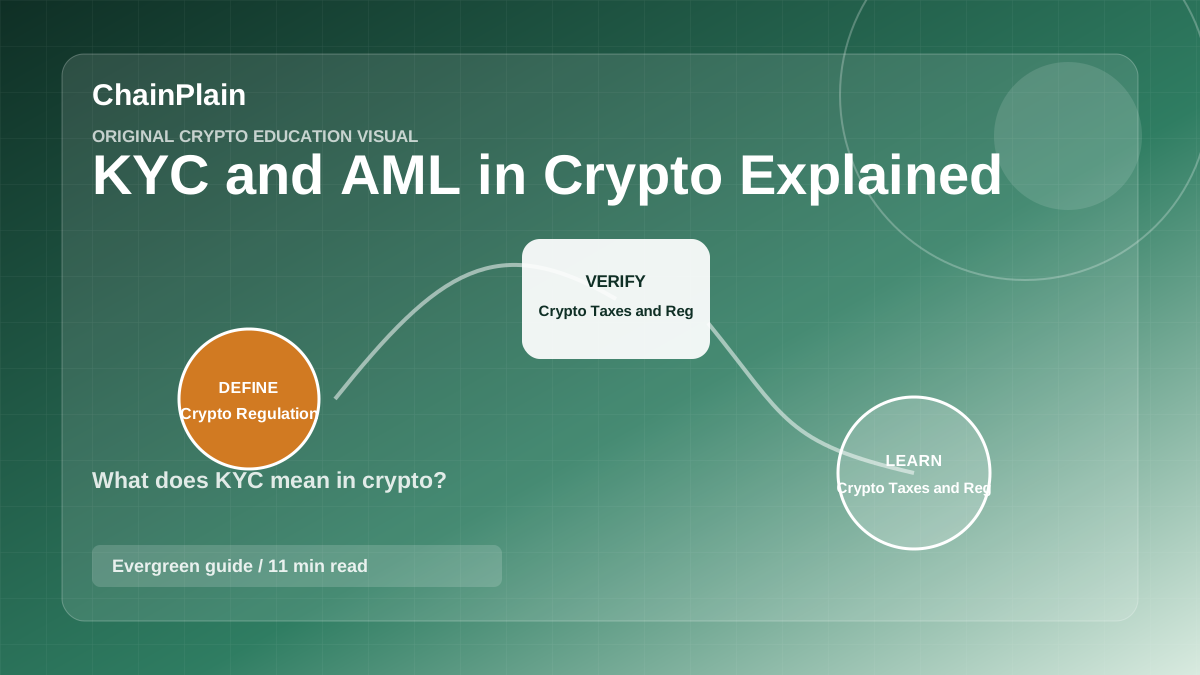
KYC and AML in Crypto Explained

KYC and AML are compliance concepts that affect many crypto exchanges and service providers, but they are different from ordinary self-custody wallet mechanics.
ChainPlain Policy Desk11 min read
KYC and AML in Crypto Explained - Crypto Regulation guide from Crypto Taxes and Regulation Hub

Content hub

Crypto Taxes and Regulation Hub

Learning path

Crypto Taxes and Regulation

Search intent

Crypto policy and tax education

Introduction

KYC and AML are compliance concepts that affect many crypto exchanges and service providers, but they are different from ordinary self-custody wallet mechanics.

Studying KYC and AML in crypto is useful because the topic sits at the intersection of software, incentives, user behavior, and public records. A beginner does not need to accept marketing claims or make financial decisions to learn the topic. The safer starting point is to define the mechanism, notice the assumptions, and separate what the technology can do from what promoters say it will do.

A Plain-Language Explanation

KYC means know-your-customer procedures used to identify customers. AML means anti-money-laundering controls designed to detect and reduce illicit financial activity. In crypto, these often apply to intermediaries such as exchanges or custodians.

For readers building a foundation in regulation, the most useful question is not whether the topic sounds exciting. The useful question is what changes hands, who can update the record, what information is visible, and what can go wrong. That framing keeps the discussion educational and avoids turning a technical explainer into a recommendation.

How It Works

The mechanics of KYC and AML in crypto are easier to understand when the system is broken into smaller parts. Different projects use different designs, but most explanations should identify the participants, the records, the permissions, the incentives, and the failure points before reaching any conclusion.

In practice, readers should expect implementation details to vary. Two projects can use the same label while making different choices about custody, governance, security, fees, disclosures, or user experience. Labels are helpful for navigation, but they are not a substitute for reading the actual documentation.

What to notice

  • Exchanges may collect identity information to meet compliance obligations.
  • Self-custody wallets and custodial accounts have different roles.
  • Privacy, access, and compliance can create tradeoffs.
  • Rules differ by jurisdiction and service type.
  • KYC and AML in crypto should be evaluated through custody, verification, costs, permissions, incentives, and failure points.

Why It Matters

KYC and AML matter because readers may confuse blockchain addresses with regulated accounts. A self-custody wallet can create an address without identity verification, while a custodial service may require personal information.

The topic also matters because crypto systems often move quickly from technical design to financial language. A clear publication should resist that shortcut. It should explain the use case, the operating model, and the risk surface before discussing market narratives. That is especially important in a YMYL topic where readers may connect education with personal financial choices.

Practical Examples

Examples can make KYC and AML in crypto easier to understand, but examples should not be read as instructions to use a product or buy an asset. They are scenarios that show how the concept appears in real interfaces, documentation, or public network activity.

Example: An exchange asks a customer to verify identity before enabling withdrawals.

Example: A self-custody wallet creates an address without opening an exchange account.

Example: A compliance review delays a transaction or account feature.

Common Misunderstandings

Many crypto mistakes begin with a small misunderstanding. A user may think a public address is private, a token listing is an endorsement, a smart contract is automatically safe, or a stable value is guaranteed. Correcting these assumptions is part of responsible education.

A second misunderstanding is that technical access equals suitability. Being able to connect a wallet, sign a transaction, or view a token on an explorer does not mean the action is appropriate for a reader's circumstances. Education can explain access without encouraging action.

What to notice

  • KYC and AML in crypto are not automatically safe because they use crypto terminology.
  • A simple interface does not remove the need to understand the transaction, permission, or source behind it.
  • Popularity, exchange listings, or social attention do not prove that KYC and AML in crypto are suitable for every reader.

Risks and Limitations

Risks and limitations deserve their own section because they are not footnotes. With KYC and AML in crypto, the risks can include software defects, market behavior, human mistakes, unclear rights, changing rules, misleading promotion, or dependencies on third parties. The right risk list depends on the exact project and use case.

Readers should also remember that a risk can be technical, legal, operational, or behavioral. A transaction may work exactly as coded and still be harmful if the user was deceived, rushed, or missing context. This is why careful crypto education avoids guarantees and avoids telling readers what to do with their money.

What to notice

  • Users may misunderstand what data a service collects.
  • Identity documents can become sensitive privacy targets.
  • Compliance status can affect account access.
  • Rules can change as regulation evolves.

Safer Learning Habits

A safer learning process starts slowly. Read primary sources, compare multiple explanations, verify links independently, and write down unanswered questions. If a topic involves taxes, law, custody, or personal finances, general articles are not enough for a personal decision.

Good research also pays attention to incentives. Ask whether the source owns tokens, earns referral fees, sells a product, or benefits from attention. Transparent conflicts do not automatically make a source wrong, but hidden incentives can distort what a reader sees.

What to notice

  • Read primary documentation before relying on summaries about KYC and AML in crypto.
  • Start with small test actions when learning a new wallet, network, or protocol flow.
  • Keep records of important transactions, addresses, dates, fees, and source links.
  • Pause when a prompt, headline, or message creates urgency.

Reader Context

Readers should understand KYC and AML in crypto separately from investment decisions, tax reporting, and platform eligibility. A concept can be technically interesting while still raising questions about consumer protection, disclosures, taxes, sanctions screening, custody, or local rules. This article is written for informational search intent, not for personal financial action.

Crypto readers often see the topic through a mix of search results, social platforms, exchange interfaces, app-store listings, tax forms, and regulatory headlines. That makes clear definitions important. Before relying on a shortcut explanation, check whether the source explains the mechanism, states its limits, and links to primary documentation or official public resources.

What to notice

  • Separate technical learning from tax, legal, and investment decisions.
  • Use official sources for tax and regulatory questions in the jurisdictions that apply to you.
  • Assume crypto transactions can create records, reporting obligations, or irreversible mistakes.
  • Treat educational examples as explanations, not instructions.

How to Evaluate Claims

A strong explanation of KYC and AML in crypto should make its assumptions visible. If a claim depends on a trusted company, a reserve report, a validator set, an audit, a bridge, a token incentive, or a legal interpretation, the claim should say so. The more a source hides those dependencies, the more cautious a reader should be.

Useful evaluation is slower than headline scanning. Compare primary documentation with independent sources, look for dates, ask what has changed, and notice whether the writer benefits if readers become excited. This is especially important for beginners because crypto marketing often borrows educational language while pushing readers toward risky actions.

A reader should also ask what a claim leaves out. Omissions about custody, fees, tax records, admin keys, bridge mechanics, withdrawal limits, or regulatory uncertainty can be as important as the claims that appear in the headline.

What to notice

  • Who operates the system, writes the code, or controls important permissions?
  • What evidence supports the claim, and is that evidence current?
  • What can fail technically, legally, operationally, or behaviorally?
  • Does the source clearly avoid price predictions and guaranteed-return language?

Source and Verification Checklist

Source transparency matters because crypto topics often combine open-source software, financial language, and fast-moving policy. A reliable guide should make it easy to verify definitions and should avoid treating anonymous social posts as proof. Primary documentation is not perfect, but it gives readers a starting point for checking what a system claims to do.

The sources below are used as starting points, not endorsements. Readers should confirm that a source is still current, compare it with other reputable materials, and remember that official documentation can describe intended behavior without removing user risk.

What to notice

  • Check FinCEN guidance and resources for primary context or independent verification.
  • Check SEC investor alerts and bulletins for primary context or independent verification.
  • Check CFTC virtual currency fraud advisory for primary context or independent verification.

Comparison Framework

A complete guide to KYC and AML in crypto should help readers compare it with nearby concepts instead of treating the term as isolated vocabulary. In crypto, the same word can appear in wallet apps, exchange interfaces, protocol documentation, tax tools, social posts, and regulatory discussions. Those contexts can use similar language while pointing to different responsibilities and risks.

The comparison process should start with mechanism. Ask what record changes, who can trigger the change, who can reverse or block it, what fees or permissions are involved, and what evidence is available to an ordinary reader. This keeps the article useful for education, search, and safety without turning it into a product recommendation or market opinion.

What to notice

  • Compare KYC and AML in crypto with the adjacent terms a beginner is likely to confuse.
  • Identify whether the issue is technical, legal, operational, behavioral, or market-related.
  • Look for the source of truth: protocol documentation, public records, official guidance, or user-controlled wallet data.
  • Notice whether a claim depends on a third party, a bridge, an issuer, a validator set, a smart contract, or a centralized interface.

Beginner Checklist

Readers who are new to KYC and AML in crypto should leave with a practical checklist. The checklist does not tell anyone what to buy, sell, hold, trade, stake, lend, borrow, bridge, or mine. It gives readers a safer way to slow down, verify terminology, and separate a learning question from a personal financial decision.

The strongest checklist is repeatable. It can be used before clicking a wallet prompt, trusting a screenshot, reading a white paper, comparing networks, opening an exchange account, or interpreting a tax statement. A repeatable process matters because many crypto mistakes happen when people improvise under pressure.

A beginner should also know what the checklist cannot do. It cannot remove volatility, guarantee software safety, replace tax or legal guidance, or prove that a project is trustworthy. Its value is narrower and more realistic: it helps readers ask better questions before risk becomes personal.

What to notice

  • Write down a one-sentence definition of KYC and AML in crypto before evaluating any claim.
  • Check whether the source is educational, promotional, sponsored, anonymous, or conflicted.
  • Verify links independently instead of following urgent messages, social posts, or direct messages.
  • Pause when a claim uses guaranteed-return language, fake scarcity, celebrity association, or pressure to act quickly.

Where This Fits in the Learning Path

The topic of KYC and AML in crypto belongs to the Crypto Taxes and Regulation learning path and supports the broader Crypto Taxes and Regulation Hub. That matters because readers rarely arrive with only one question. Someone searching for KYC crypto may also need help with wallet safety, tax records, transaction mechanics, source evaluation, or scam prevention.

A well-built learning path should move from definitions to mechanisms, then from mechanisms to risks, and finally from risks to safer research habits. This article is one step in that path. It should help readers understand the topic well enough to ask better follow-up questions and recognize when a topic requires official sources or qualified professional advice.

What to notice

  • What does KYC mean in crypto?
  • Why do crypto exchanges ask for ID?
  • Is a self-custody wallet KYC?
  • How are crypto taxes different from crypto technology?
  • Which agencies discuss crypto?
  • Why does crypto regulation vary by activity?

Key Takeaways

The main lesson is that KYC and AML in crypto should be studied as a system rather than a slogan. A thoughtful reader looks at the mechanism, the people and organizations involved, the incentives, the public data, and the unresolved risks. That approach is slower than hype, but it produces better understanding.

What to notice

  • KYC and AML in crypto are best understood as mechanisms with assumptions and tradeoffs.
  • Clear definitions, primary sources, and risk context make beginner research safer.
  • Educational understanding should remain separate from personal financial decisions.

FAQ

What are KYC and AML in crypto in simple terms?

The term KYC and AML in crypto refers to a crypto topic that should be understood by looking at how it works, who controls important steps, what records are created, and what risks a reader should notice.

Why do KYC and AML in crypto matter?

It matters because KYC and AML in crypto can affect how users interpret wallets, transactions, applications, security decisions, tax records, or protocol claims.

What is the main risk with KYC and AML in crypto?

The main risk is usually misunderstanding the mechanism, trusting an incomplete source, or treating a technical explanation as personal financial advice.

Sources and Further Reading

These links are starting points for independent verification. They do not represent endorsements of any asset, product, or service.

Update History

ChainPlain updates evergreen guides when source material, terminology, risk context, or reader needs change. Updates do not represent investment, legal, or tax advice.

  • : Initial educational guide published.
  • : Reviewed for source quality, risk framing, clarity, and global reader context.
Crypto Regulation: Why It Matters - Crypto Taxes and Regulation guide from Crypto Taxes and Regulation Hub
RegulationGuide10 min read

Crypto Regulation: Why It Matters

Crypto regulation is the set of laws, rules, and supervisory expectations that may apply to digital asset activity. It varies by jurisdiction and changes over time.

Crypto Taxes and Regulation

ChainPlain Policy Desk
Crypto Tax Basics for Beginners - Crypto Taxes guide from Crypto Taxes and Regulation Hub
RegulationGuide11 min read

Crypto Tax Basics for Beginners

Crypto tax basics start with records, taxable events, cost basis, and the difference between general education and advice from a qualified tax professional.

Crypto Taxes

ChainPlain Policy Desk
Crypto Tax Records: What Beginners Should Track - Crypto Taxes guide from Crypto Taxes and Regulation Hub
RegulationGuide11 min read

Crypto Tax Records: What Beginners Should Track

Crypto tax records help readers reconstruct what happened across wallets, exchanges, networks, and protocols before tax or accounting questions become urgent.

Crypto Taxes
ChainPlain Policy Desk